Features
What PayUp actually does
Eight things, in the order you would meet them.
Scan the receipt, and let it do the typing
Photograph the receipt at the table, pick an image out of the camera roll, or upload a screenshot — a Lyft receipt or an emailed order confirmation reads exactly like a photograph of a till receipt. PayUp pulls out the descriptions, quantities and prices, and a line reading “3 × Taco” arrives as three separate items, each priced to the cent.
If the receipt has no printed tip line, one is filled in at 20% of the pre-tax subtotal — what US tipping etiquette actually asks for. Set your own rate once in settings and it applies from then on. And you can start from the scan itself: point the camera first and name the trip afterwards, rather than creating somewhere to put the receipt before you have read it.
Everyone assigns items at once, on their own phone
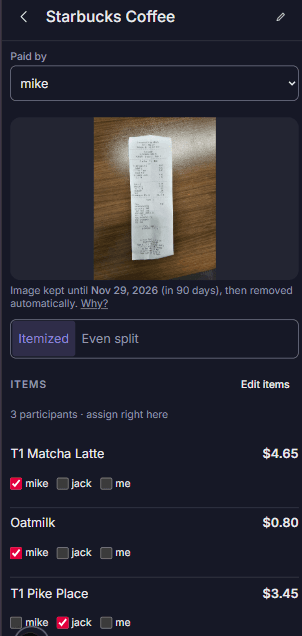
Two or three people can work on the same receipt at the same table. Tap who had what and it appears on the other screens as it happens, so nobody is reconciling two versions afterwards or asking whether somebody has already done the drinks. A shared plate divides between the people on it; something genuinely communal spreads across everyone at once.
Who paid is recorded per receipt, not assumed from whoever photographed it — so one person can add the whole weekend and still record that somebody else covered Friday. Change it later from the receipt and every total, and the settle-up, follow immediately.
Share a trip, or the one receipt you are asking about
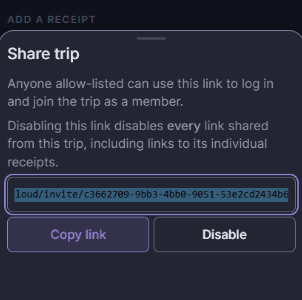
Send an invite link however you already talk to these people. Anyone who opens it joins the trip and gets a free account on the way in — no app store detour, no code to read out.
You can also share a link to a single receipt, so the person you are asking lands on the thing in question rather than on a trip page with a list to search. If that receipt has since been deleted, the link quietly opens the trip instead of failing. Both are the trip's one invite link, so disabling it stops all of them at once.
Add the things that never had a receipt
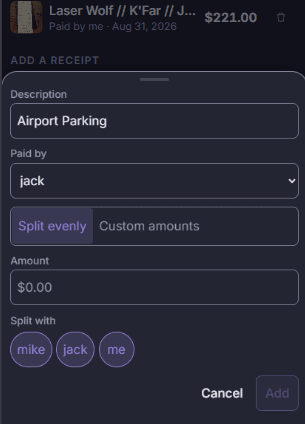
A taxi paid in cash, the parking, somebody covering the tickets. Type the name, say who paid, then either split it evenly between the people it covers — not necessarily everyone on the trip — or type each person’s share directly.
Fixed amounts sit in the trip beside the receipts and settle up with them, and they are never metered: there is no photograph to read, so there is nothing to charge for.
A ledger for each person, not just a list of transfers
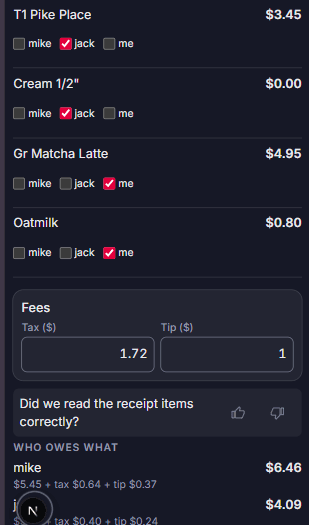
Every receipt and every fixed amount in the trip is netted off together, then reduced to the fewest transfers that clear everyone — not one payment per bill, and nobody fronting money they are only going to pass along. It recalculates as receipts arrive, so there is no reckoning to sit down and do at the end.
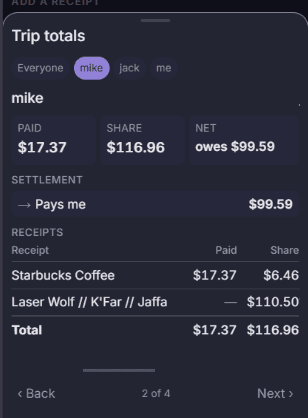
Then each person gets their own page: what they paid, what they actually consumed, which way the money goes in words rather than in a minus sign, and receipt by receipt why — footing exactly to the share the ledger gave them. A transfer list can tell you what to pay. This is what settles the argument about whether it is right.
Change who is on the trip at any point
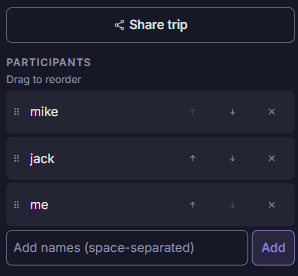
Somebody turned up on the second night, or never turned up at all. Add them, remove them, or drag the list into the order you actually read it in, and every total and the settle-up recalculate from there.
Participants can be names you typed — enough to split a bill and settle up with somebody. An account is only needed by people who want their own view: to add the receipt from the meal you missed, or to check the arithmetic. Neither is required for the split to be right.
It is there when the signal is not
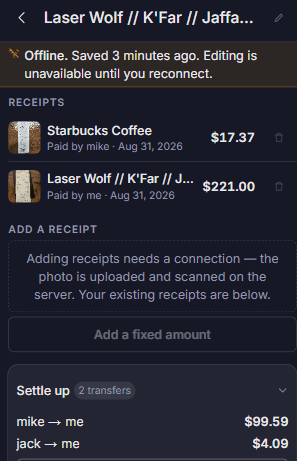
Restaurant basements, rural cottages, aeroplanes, and the last bar of the night. Trips you have opened are kept on the device together with their receipts, and the settle-up figures are worked out on the phone rather than fetched — so the answer to what do I owe you is there with no connection at all.
PayUp says plainly when what you are looking at came from the cache, rather than presenting stale numbers as current ones.
3 free scans, then 1 a month
Every account starts with 3 scanned receipts at no cost, kept until you use them — there is no clock on them. After that it is 1 free scan a month, arriving on the first.
Fixed amounts are not metered at all, so a trip can carry as many of those as it needs on any plan.
And beyond the free allowance
It's $2.99 a year — one payment, not a monthly subscription. See pricing →